
Bangladesh is an important tea-producing country. It is the 9th largest tea producer in the world. Sylhet is the birthplace of the tea industry in Bangladesh and home to the oldest tea garden in the Indian subcontinent, Malnicherra Tea Estate. Over time, tea expanded south into the hills around Chittagong and parts of the Chittagong Hill Tracts, where similar agro‑ecological conditions allowed plantations to grow on slopes and ridges. The geography story changed again with the rise of Panchagarh in the far north. Unlike Sylhet’s and Chittagong’s hills, Panchagarh offers relatively flat land, cooler temperatures, and good road access. Here, tea is grown more like a field crop, often with more mechanization and larger contiguous blocks of flat plantations. Today, the country has 166 commercial tea estates, including many of the world’s largest working plantations. The industry accounts for 3% of global tea production, and employs more than 4 million people. To sustain this massive scale, Cultive8 Technologies is working alongside major producers to bring data-driven precision to traditional field management.
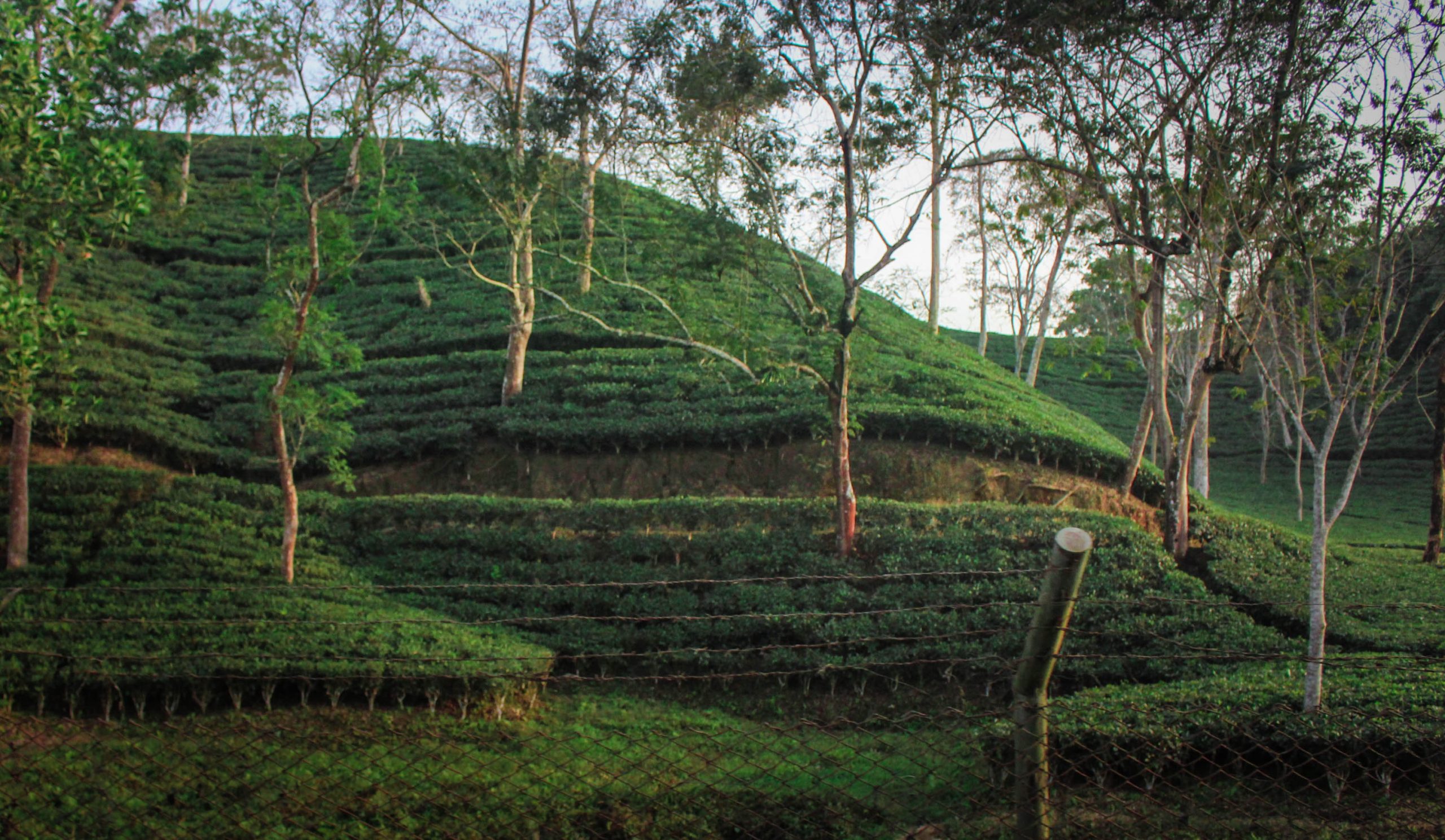
Why Sylhet Is Good for Tea
Tea is a demanding crop. It needs warmth, humidity, regular rainfall, and the right kind of soil. Sylhet ticks many of these boxes naturally. The region has a warm, humid climate and high rainfall, which support continuous leaf growth for much of the year. Tea doesn’t like waterlogged conditions. That’s why in Sylhet; tea plantations are laid out on gentle hills and slopes where water drains away quickly.
How Tea Is Cultivated
- Preparing the Land First, the land is surveyed and divided into blocks and plots so that work can be organized and movement is efficient. Trees, shrubs, and old vegetation are cleared, and the soil is loosened. On steeper slopes, contours or terraces are laid out to reduce erosion when the heavy monsoon rains arrive.
- Planting the Tea Bushes Tea in Sylhet is usually planted as selected varieties or clones—types known for high yield and good quality under local conditions. Seedlings or cuttings are raised in nurseries and then transplanted into the field in long rows with consistent spacing.
- Managing the Growing Bushes The bushes are pruned regularly to maintain height and stimulate new shoots. Without pruning, bushes grow too tall and produce fewer tender leaves. Estates apply fertilizers and organic matter to support growth. Nutrient loss is a constant issue because heavy rainfall can carry fertilizers away, so timing is crucial. Weeds compete for water and nutrients, and pests can destroy leaves. Tea gardens use a mix of manual weeding and selective chemicals while trying to keep costs in check.
- Plucking Plucking is where the human story of tea becomes visible. In Sylhet, as in the rest of Bangladesh, most pluckers are women from tea worker communities. Workers move along the rows and pick the tender parts of the plant—typically “two leaves and a bud”—which are ideal for making quality black tea. Taking more leaves at once, increases quantity but can reduce quality.
- Processing Most large Sylhet gardens have their own factories. Fresh leaves are spread out so some moisture evaporates and the leaves soften. Leaves are rolled to break cell walls, helping natural juices mix and oxidation to begin. Leaves are kept under controlled conditions to develop aroma and color. Heated air is used to stop oxidation and bring moisture down to a stable level. Dried tea is separated into grades by size and quality, ready for auction and packaging.
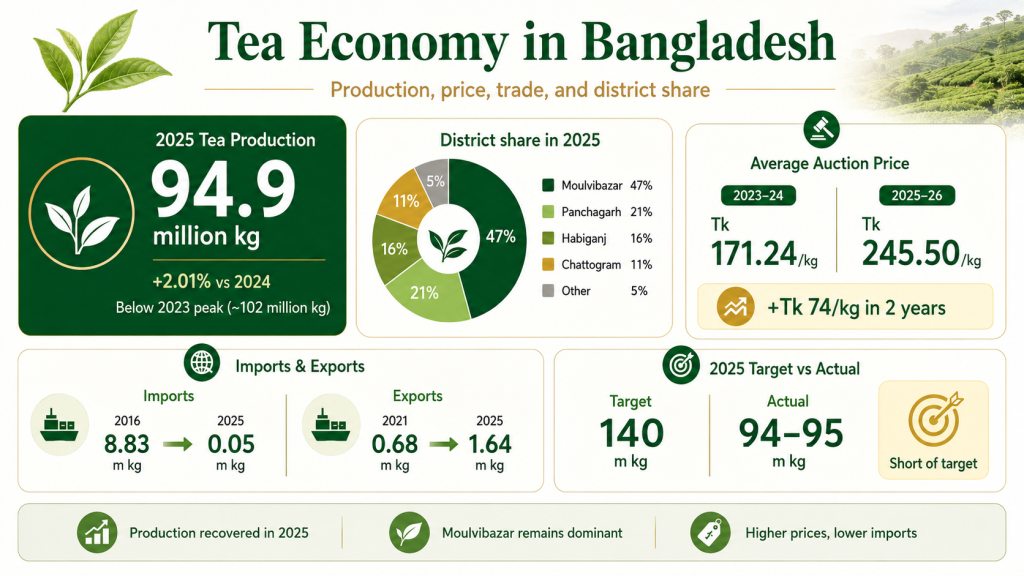
Tea Economy in Bangladesh
- National tea production in Bangladesh reached about 94.9 million kg in 2025, a 2.01% increase over 2024. However, this is still below the 2023 record of roughly 102 million kg, largely due to weather and cost pressures.
- In 2025, Moulvibazar accounted for 47% of national tea production, making it the dominant tea district. Panchagarh contributed 21%, Habiganj 16%, and Chattogram 11%, highlighting the growing role of northern flatland tea alongside traditional Sylhet‑region hills.
- The average auction price rose from Tk 171.24/kg in 2023‑24 to Tk 245.50/kg in 2025‑26, an increase of more than Tk 74/kg in two years.
- Tea imports fell from 8.83 million kg in 2016 to just 0.05 million kg (50,000 kg) in 2025, a decade‑low level, as domestic production increasingly met local demand. Tea exports recovered from 0.68 million kg in 2021 to 1.64 million kg in 2025, more than doubling in four years, though still small relative to total production.
The government had targeted 140 million kg of production by 2025, but actual output (around 94–95 million kg) fell far short of this goal.
The Modern Challenges Facing Tea Managers
Through deep-dive field research across Bangladeshi tea gardens, the agronomic analytics team at Cultive8 identified three structural bottlenecks that consistently drain plantation profitability: Labor Tracking, Leaf-Weight Discrepancies, and Factory Throughput Optimization.
Labor Tracking
Tea remains highly labor‑intensive, especially in plucking. Each worker’s output depends on skill, effort, terrain, and plant condition. Traditionally, supervisors record leaf weights and attendance manually, often on paper. This creates several issues:
- Inaccurate or delayed records make it hard to link wages to actual productivity.
- Supervisors may struggle to monitor large teams spread across wide, hilly blocks.
- Management lacks real‑time visibility into who is working where and how much is being plucked.
Leaf‑Weight Discrepancies
One persistent pain point is discrepancies between what workers claim to have plucked, what supervisors record, and what eventually reaches the factory’s intake point. Common problems include:
- Misreporting or rounding up weights at field collection points.
- Losses or mixing during transport from field to factory.
- Differences between field scales and factory scales.
Factory Optimization
Once leaves arrive at the factory, another set of challenges begins. Tea quality and cost strongly depend on how well the factory is run. Key optimization issues include:
- Matching plucking volume to factory throughput so leaves are processed quickly, avoiding quality losses due to delays.
- With fuel and electricity costs rising, managers must minimize waste in withering, drying, and other energy‑intensive stages.
- Consistency in withering time, rolling intensity, oxidation conditions, and drying temperature is vital for uniform quality across batches.
- Breakdowns in critical machinery (driers, rollers, sorters) can cause backlogs, lower quality, and extra labor costs.
Cultivating tea is an art, but managing an estate is a complex science. Discover how leading tea conglomerates like Ispahani and Finlay partner with Cultive8 Technologies to deploy the AgriGEN ERP architecture. By digitizing field logs, Cultive8 helps estates eliminate leaf inventory tracking leakages and unlock real-time analytics from bush to auction house. Book a customized AgriTech consultation for your agribusiness today.