
The poultry sector in Bangladesh is an important part of the country’s agribusiness, making up roughly 35-40% of the country’s animal protein, supporting the livelihoods of millions of smallholders, and providing an estimated annual value of BDT 300–350 billion (USD ~3–3.5 billion) across the broiler, layer, and hatchery parts of the industry. Rapid urbanization and rising incomes are creating a steady demand for eggs and chicken meat, while processors, supermarkets and exporters are demanding higher quality, traceability and consistency. However, despite this commercialization, most farms, especially small and medium enterprises that are the backbone of the sector – still rely on manual record keeping: paper notebooks, wall charts and handwritten tags. This low-tech default hides a costly reality. As producers scale up or enter formal value chains, fragmented, inconsistent records become a bottleneck to productivity, compliance, and access to higher value markets.
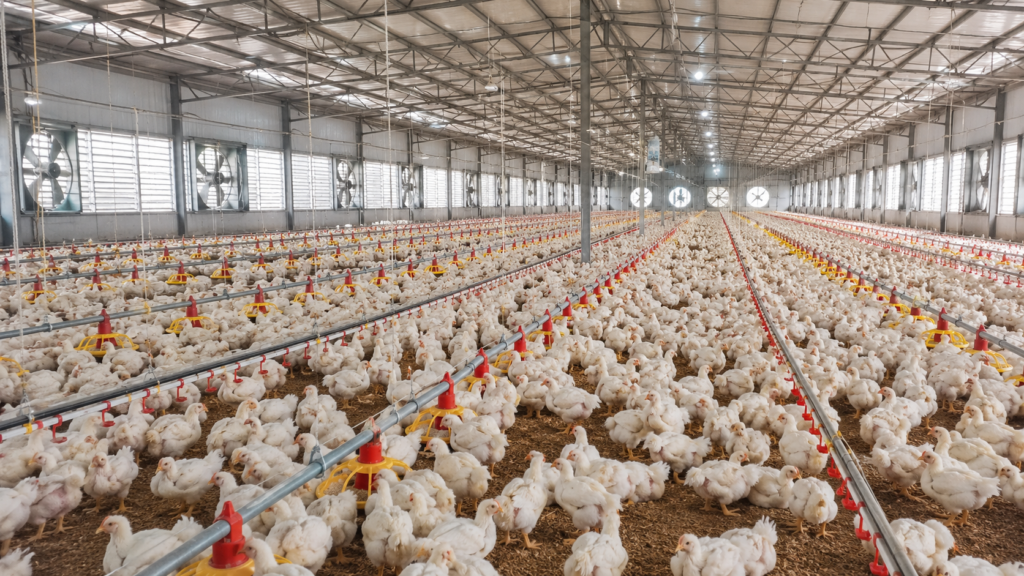
4 Critical Bottlenecks of Manual Paper Logging in Poultry Management
- FCR (Feed Conversion Ratio) blindspots
Manual recording and inconsistent units make it hard to calculate reliable FCR, a core metric for both broilers and layers. Small errors in feed quantities, spillage, or incorrect bird counts create large swings in calculated FCR.
- Mortality and vaccination delays
Paper logs and delayed transcription slow detection of emerging disease patterns and missed vaccination windows. Manual systems also make it harder to confirm dosing and schedules across multiple houses, increasing the risk of under- or over-vaccination and consequential production losses.
- Hatchery incubation & climate vulnerability
Hatchery operations depend on closely monitored temperature, humidity and candling records. Manual entries are often intermittent and lack timestamps, so deviations in incubation conditions go undocumented or unnoticed until hatch rates drop.
- Batch & traceability gaps in feed
Feed is often purchased in bulk and repacked on farm; manual logs rarely capture batch numbers, supplier lot codes, or feed mill certificates consistently. When feed quality issues arise (mycotoxins, nutrient imbalances), farms can’t trace which batches were used where, forcing broad crop-level responses or rejecting buyer certifications.
The Financial Impact of Manual Logging on Poultry Farms
Manual logging may seem inexpensive, but inaccurate or delayed records can create major financial losses in poultry farming. Feed consumption, mortality, bird weight, medicine use and stock movement are often recorded in separate notebooks, making problems difficult to detect early.
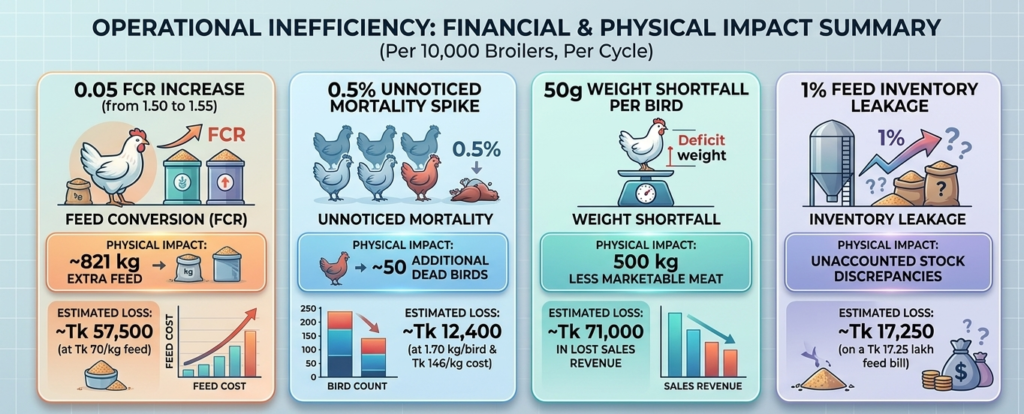
Feed represents around 70–80% of poultry production costs in Bangladesh. For a commercial operation running 10,000 broilers, minor paper-logging inaccuracies compound into significant financial losses per cycle:
| Operational Inefficiency | Physical Impact (per 10,000 Broilers) | Estimated Financial Loss (per Cycle) |
| 0.05 FCR Increase (from 1.50 to 1.55) | Requires ~821 kg of extra feed | ~Tk 57,500 (at Tk 70/kg feed) |
| 0.5% Unnoticed Mortality Spike | ~50 additional dead birds | ~Tk 12,400 (at 1.70 kg/bird & Tk 146/kg cost) |
| 50g Weight Shortfall per Bird | 500 kg less marketable meat | ~Tk 71,000 in lost sales revenue |
| 1% Feed Inventory Leakage | Unaccounted stock discrepancies | ~Tk 17,250 (on a Tk 17.25 lakh feed bill) |
| Total Cumulative Loss Exposure | Multiple compounded operational errors | Tk 29,000 to Tk 1,40,000+ per cycle |
The hidden cost of manual logging is therefore not just the time spent writing in registers. It is the money lost when farm owners cannot identify problems early, compare flock performance accurately or make decisions using reliable data.
A Practical 7-Step Roadmap to Farm Digitization
Digitizing a poultry farm does not require replacing every process at once. Farms can begin by moving their most important daily records from notebooks to a mobile or web-based system.
A practical digitization process can begin with:
- Digital flock and shed records: Store flock size, chick source, placement date, shed number and expected market date in one system.
- Daily feed, mortality and weight entry: Record daily feed use, bird deaths and sample weights to monitor flock performance.
- Medicine and vaccination tracking: Keep records of medicines, dosages, vaccination dates and treatment history.
- Feed and inventory management: Track feed, medicine and other supplies from purchase to daily use and closing stock.
- Automated FCR and profitability reports: Automatically calculate feed conversion ratio, production cost, revenue and estimated profit.
- Alerts for unusual performance: Receive notifications when mortality rises, feed use changes or bird growth falls below target.
- Mobile dashboards for owners and managers: View farm performance, stock levels and financial summaries from a mobile phone or computer.
Modernize Your Agribusiness Operations Today
Stop letting manual data gaps drain your farm’s profitability. Discover how Cultive8 Technologies helps commercial poultry, hatchery, and agro-enterprises digitize shed-level operations and streamline supply chain visibility with specialized AgriTech software architectures.