
Bangladesh’s tea industry is dominated by two traditional growing regions, Sylhet (especially Moulvibazar) and Chittagong, but they differ markedly in scale, agro-ecology, and market dynamics. Sylhet is the country’s tea heartland, contributing to the majority of national output and hosting most estates, while Chittagong plays a smaller but strategically important role as the main auction and export hub.
Environment, Cultivation, and Tea Variants
The environmental conditions and agronomic practices of Sylhet and Chittagong shape distinct tea characteristics and yield profiles:
A. Sylhet
Sylhet features a humid subtropical climate with high, regular monsoon rainfall and undulating rolling hills (tillahs) and low basins (bheels). The soil is rich, deep, and acidic with high organic matter, creating ideal conditions for continuous leaf growth. The region primarily cultivates high-yielding CTC (Crush, Tear, Curl) black tea clones developed by the Bangladesh Tea Research Institute (BTRI). These produce strong, brisk, full-bodied teas with rich liquor color, graded highly under Categories A, B, and C.
B. Chittagong
Chittagong and the adjacent Hill Tracts feature steeper, erosion-prone slopes, variable microclimates, and coastal maritime humidity. The soil layer is often shallower, making bushes more vulnerable to dry season drought stress and soil erosion. Consequently, gardens in Chittagong frequently feature older seedling planting material alongside specialized varieties. The resulting tea profile is often lighter with distinct aromatic notes, typically categorized under Types I, II, and III reflecting its unique regional microclimate.
Market Structure and Auction Dynamics
Auction Centres:
- Bangladesh has three main tea auction centres: Chittagong, Sreemangal (Moulvibazar, Sylhet), and Panchagarh.
- Chittagong auction is the oldest and largest, handling a major share of national sales, including tea from Sylhet estates that must be transported to the port city.
- Sreemangal serves the Sylhet cluster directly, reducing transport costs for those estates, while Panchagarh caters to the northern flatland tea zone.
Price Trends and Regional Impacts:
- In recent seasons, Chittagong auction prices have shown increases, even as supply and prices at Sreemangal and Panchagarh have declined in some rounds, indicating region‑specific demand and quality differentials.
- Because most Sylhet tea can be sold either at Sreemangal or Chittagong, planters in Sylhet can sometimes optimize logistics and price realization better than smaller Chittagong gardens, which are more dependent on the Chittagong auction.
Sylhet vs. Chattogram: At a Glance
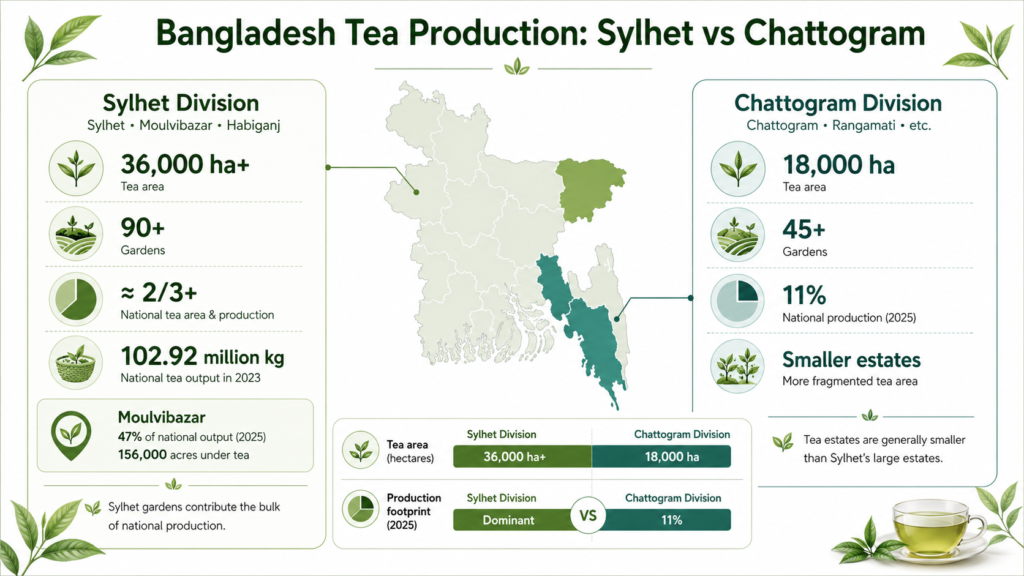
| Feature | Sylhet | Chittagong |
| Share of National Production | ~67%–70% | ~11% |
| Cultivated Area & Gardens | ~36,000 hectares across 90+ large estates | ~18,000 hectares across 45+ smaller gardens |
| Terrain & Agro-Ecology | Rolling hills (tillahs) & flat basins (bheels); high rainfall | Steeper, erosion-prone slopes; variable microclimates |
| Yield & Grading | Higher yield/ha; graded under Tea Board Categories A, B, C | Lower average yield/ha; graded under Categories I, II, III |
| Primary Auction Gate | Sreemangal Auction & Chattogram Auction | Main Chattogram Auction Hub |
How Cultive8 Customizes AgriGEN ERP for Each Region
Because Sylhet and Chittagong face completely different operational bottlenecks, Cultive8 Technologies customizes its AgriGEN ERP deployment to solve the exact challenges of each regional landscape:
For Sylhet:
Sylhet’s massive, sprawling plantations spread over thousands of acres across multiple hilly blocks. Cultive8 customizes AgriGEN for Sylhet by focusing heavily on estate-wide workforce, weighment, and field tracking:
- Bluetooth Scale Integration: Digitizes field plucking weighments directly at remote collection points across hilly blocks, eliminating pen-and-paper tampering.
- Multi-Block Division Management: Connects remote field divisions into a single central dashboard, giving estate directors real-time visibility over leaf movement and labor productivity.
- Logistics Optimization: Streamlines leaf dispatch whether estates choose to sell at the local Sreemangal auction or ship to Chittagong.
For Chittagong:
In Chattogram, where gardens are smaller, yield per hectare is lower, and operational margins are tighter; garden survival depends on strict factory cost controls. Cultive8 customizes AgriGEN for Chattogram by introducing a specialized Manufacturing & Factory Optimization Module:
- Withering & Drying Energy Tracking: Monitors fuel and electricity consumption per kilogram of processed leaf to minimize factory utility waste.
- Throughput Matching: Syncs incoming green leaf volume directly with factory processing capacity, preventing leaf degradation and quality loss during delays.
- Batch Quality & Cost Control: Tracks the exact cost-per-kilogram from leaf intake to final auction grading, helping Chattogram managers protect profit margins despite higher unit costs.
Sylhet and Chattogram represent two distinct pillars of Bangladeshi tea, one driven by massive field scale, the other by strategic processing and port proximity.
By deploying customized AgriGEN ERP modules tailored specifically to Sylhet’s multi-block field logistics and Chattogram’s factory manufacturing efficiencies, Cultive8 Technologies gives estate managers across Bangladesh the exact tools they need to cut operational leakages and maximize profit margins.